U.S. Department of State, Public domain, via Wikimedia Commons

By Madelynn Linet
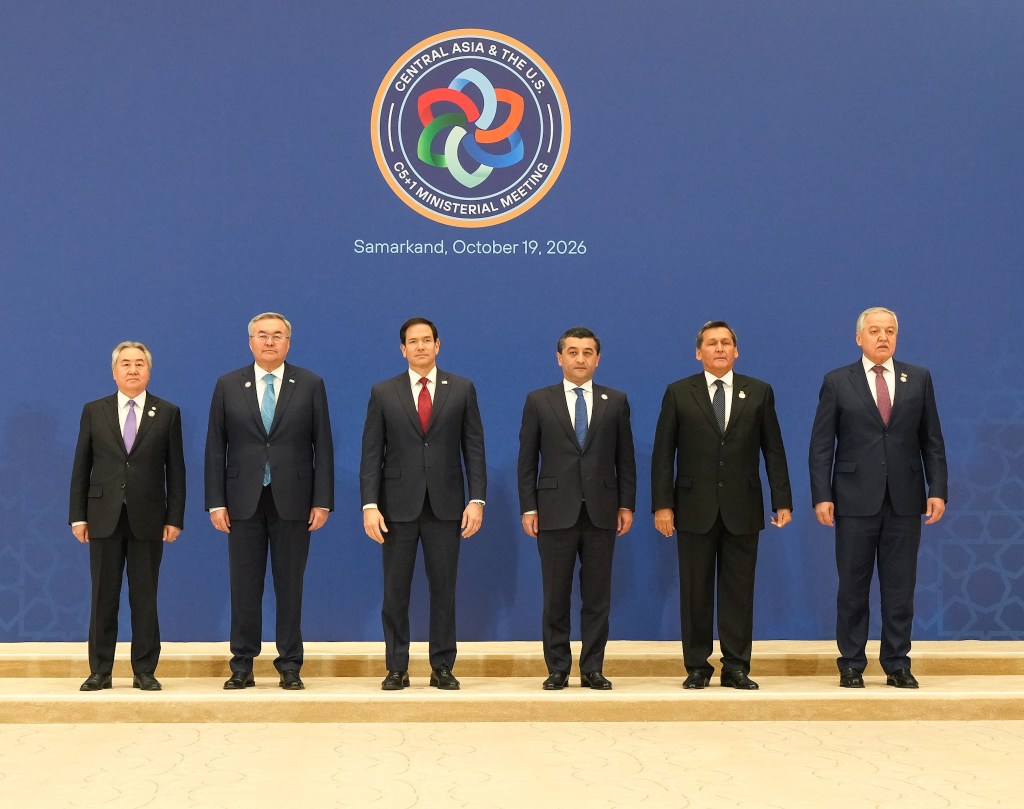
On October 19th, 2026, U.S. Secretary of State Marco Rubio met with the foreign ministers of Kazakhstan, Kyrgyzstan, Tajikistan, Turkmenistan, and Uzbekistan for the latest meeting of C5+1. The meeting took place in Samarkand, Uzbekistan, and marked roughly a decade of cooperation between the United States and Central Asia. The first C5+1 meeting was also held in Samarkand on November 1st, 2015, with former U.S. Secretary of State John Kerry. Since its creation, C5+1 has provided the United States with a regional forum for engaging with Central Asian governments. Rather than approaching each country through disconnected bilateral negotiations, the framework gives all six governments an opportunity to discuss joint problem-solving, shared challenges, common interests, and coordinated cooperation.
The C5+1 was initially established in 2015 with the intention of strengthening economic, energy, and security cooperation amongst the member states. Since its inception, the C5+1 has expanded from a talk-heavy diplomatic framework to a highly structured strategic partnership. Over the past decade, the initiative has also included presidential-level engagement, including the 2023 summit in New York and the 2025 meeting at the White House. The October 2026 meeting demonstrates how this framework is becoming an important part of U.S. foreign policy toward Central Asia. It also demonstrates how the region has become increasingly relevant to discussions about international trade, global supply chains, and energy security.
Meeting Outcomes
The October meeting produced several important outcomes for both Central Asia and the United States. All six of the governments represented adopted a joint statement titled C5+1: Historic Partnership, Prosperous Future. The statement reaffirmed the countries’ commitment to working alongside one another while also respecting the integrity, independence, and sovereignty of each country. It also identified several priorities for future cooperation, including critical minerals, energy, security, transportation infrastructure, and economic partnerships.
One of the major areas of discussion was investment in the Trans-Caspian Trade Route, also known as the Middle Corridor. The route connects China and Central Asia to Europe through the Caspian Sea and the South Caucasus. This opens up a connection between countries within the C5 and European markets, allowing for greater economic relationships. The trade route also reduces freight transport times, creates opportunities for cross-border investment, and allows for the development of various kinds of infrastructure like ports and railways, generating additional employment opportunities. Improving the Middle Corridor allows Central Asian countries more options for moving goods to Europe without relying exclusively on routes that move through Russia. However, the corridor will require continued investment and coordination among the countries involved before it can reach its full potential.
Energy is also an important pillar of the C5+1, with discussions about critical minerals being a pivotal point of the summit. One of the biggest priorities of Rubio’s visit was to expand economic cooperation between the U.S. and Central Asia. Rubio emphasized opportunities for trade, investment, energy development, and access to critical minerals. Within Central Asia, there are significant reserves of uranium, natural gas, and other minerals that are increasingly important for advancements in technology. The joint statement emphasized the importance of developing high-value supply chains and expanding mineral processing within Central Asia. This is significant because it creates opportunities for countries in the region to move beyond exporting raw materials and develop internal industrial capabilities. Following the meetings in Samarkand, Uzbekistan announced 54 different agreements and proposed projects with American partners worth nearly $12 billion. These agreements covered various areas of potential cooperation and demonstrated the growing relationship between the United States and Uzbekistan. It is important to note that Uzbekistan is currently the world’s fifth-largest uranium supplier and holds reserves of multiple other kinds of rare and critical metals. This makes it a significant potential partner in discussions about energy and critical mineral supply chains.
Security was also a major part of the joint statement that was created as a result of the C5+1 meeting. The governments emphasized cooperation on counterterrorism, border security, human trafficking, transnational organized crime, and other issues. Cybersecurity and nuclear security were also among the included priorities. These areas further demonstrate that this relationship is not only focused on investment and trade opportunities. The U.S. and Central Asian governments also have shared concerns over security that require continued discussions, communication, and cooperation.
What this Means for the Future
The C5+1 now faces the questions that follow an organization any time an announcement is made: whether the summits can turn into things that operate. The United States has expressed a deep interest in critical minerals, secure transport routes, and strategic influence. Central Asian governments are interested in investment, market access, and the freedom to maintain relationships with multiple global powers. Although these interests overlap, there is a requirement for follow-up and follow-through for any accomplishment to actually occur. The joint statement provides a foundation for future cooperation but does not guarantee that the proposed initiatives will be completed. Within the joint statement from the latest meeting, mineral processing, energy cooperation, and cybersecurity were among the major priorities identified. However, there were no figures given for new infrastructure funding. This makes implementation an important part of the partnership’s success. The next ministerial meeting of the C5+1 may show how much of this year’s discussions became completed projects. The last decade of the C5+1 established a foundation for cooperation. Its next decade will be measured by what the member states are able to accomplish together.


Leave a Reply