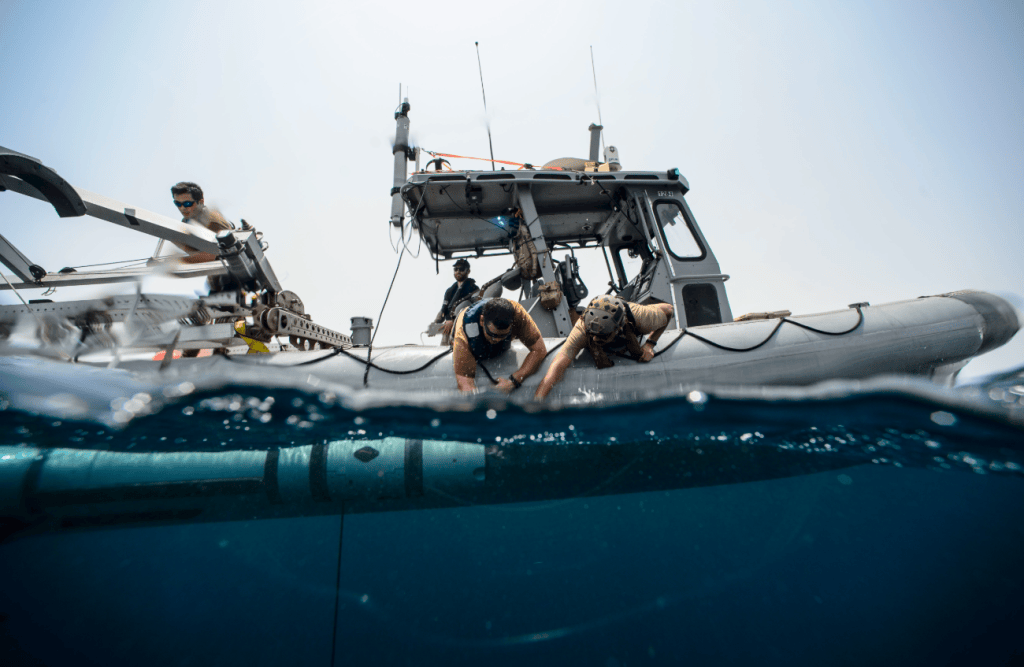
U.S. Navy photo by Mass Communication Specialist 2nd Class John Paul Kotara II/Released, Public domain, via Wikimedia Commons

By Taylor Bishop
“For whosoever commands the sea commands the trade; whosoever commands the trade of the world commands the riches of the world,” said Sir Walter Raleigh. Raleigh’s quote comes from the 1600s, when he analyzed the maritime influence of Portugal and Spain and a slowly emerging England; it still fits today’s context of naval supremacy, especially in East Asia.
The maritime security competition in East Asia is not new, but it has intensified due to advancing technology, regional security concerns, and the growing rivalry between the United States and China. East Asia contains some of the world’s most transited maritime routes and straits. Consequently, maritime security changes in the region have implications not just for competing actors but also for the broader international economy and community. But what does this mean for regional security, and how are emerging technologies such as autonomous vessels reshaping the maritime balance?
In October, the PLA Navy conducted large-scale maneuvers around critical maritime chokepoints in the West Pacific near Taiwan, Japan, and the Philippines, which some analysts interpreted as preparations for or simulations of potential regional conflict scenarios. This occurred days before the U.S. and the Japanese Self-Defense Forces, among many other participating allies, were set to begin Keen Sword 27, an exercise meant to mimic the defense of Japan’s southern Islands near Taiwan. Amidst these exercises and maneuvers is a growing dimension to maritime security: autonomous vessels, which were reportedly used in the Keen Sword 27 exercise. However, this was not the first major time that autonomous systems were used in a large-scale maritime maneuver; recall that in early October the US, in conjunction with its partners and allies from the U.K. and Australia, conducted AUKUS Pillar II in which numerous autonomous systems were used in the exercises alongside manned ones.
While autonomous vessels are nothing new in modern warfare, they add a new dimension to maritime security and deterrence that could reshape maneuvers, operations, and the capabilities of naval forces in East Asia, given their adaptive role. Recently, the Australian Navy announced the deployment of the autonomous vessel “Ghost Shark,” which can carry supplies, sea mines, and hundreds of unmanned aerial vehicles. This followed the US Navy’s introduction of its own autonomous vessel, the Orca XLUUV. Japan has also integrated autonomous vessels into the Japan Maritime Self-Defense Force (JMSDF), further expanding their use across the region.
Unmanned Surface Vehicles (USVs) and Unmanned Underwater Vehicles (UUVs) are expanding rapidly across the Western Pacific; they add a new layer to security, deterrence, and capabilities for actors in the area, which can increase the likelihood of a crisis or help de-escalate it. That said, cost is a key driver behind the adoption of autonomous systems. According to some analysts, these vessels offer cost-saving effectiveness, allowing states to produce them in large quantities with numerous capabilities, unlike traditional naval vessels, which take significant time and resources to build. Take the war in Ukraine, where Kyiv has managed to constrain the more expensive-to-build and maintain Russian Black Sea fleet by using Autonomous Surface Vessels and missiles. Recent U.S. operations involving Iran have also demonstrated the operational value of unmanned maritime systems, particularly in surveillance, force protection, and offensive operations. According to researchers, the war with Iran could take years for munitions to be replenished to pre-conflict levels, forcing policymakers and military personnel to shift priorities to cheaper alternatives such as USVs and UUVs. This alleviates the gaps in security and deterrence when flashpoints emerge, such as those that might occur in the South China Sea.
What will arguably be the biggest aspect of introducing these autonomous systems into the region is regional actors’ ability to leverage proximity over security deterrents. If a crisis or conflict were to emerge in the South China Sea, actors would not necessarily need to match a rival’s conventional naval strength ship for ship. Instead, fleets of USVs and UUVs could provide a relatively cost-effective way to impose risks or deterrence on larger naval forces operating near contested waters or maritime routes. James E. Auer and Robyn Lim highlighted this proximity dilemma in 2001, in which they drew comparisons to Germany in World War I and the U.S.S.R. in the Cold War, where each respective power didn’t need to subdue their foes across the world but rather focus on the chokepoint or specific region that offered the greatest gain.
In East Asia, however, proximity adds a complex layer to an already competitive region, where competing interests and the balance of power can shift. For states unable or unwilling to sustain large and expensive naval fleets for security and deterrence, autonomous systems can offer a cost-effective means to that end. For the United States and its regional partners like Australia and Japan, successfully integrating UUVs and USVs could strengthen regional posture as financial constraints force institutions to adopt cheaper alternatives, while also increasing the risk of intensifying competition in contested waters. As this technology matures, the balance of maritime power in East Asia may depend not only on who commands the seas but on who best integrates autonomous systems into them.


Leave a Reply