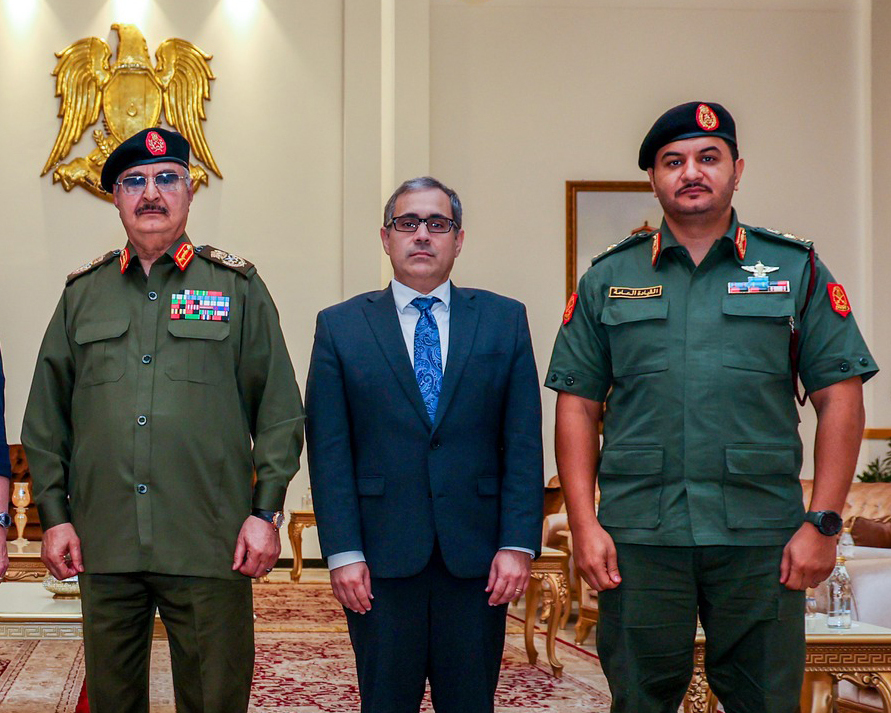
US Government, Public domain, via Wikimedia Commons

By Allie Heiniger
On October 20, Libya’s eastern-based House of Representatives approved a maritime agreement with Turkey that it had rejected for years. The deal was first signed in 2019 by Turkey and Libya’s Tripoli-based government and drew a maritime boundary across contested parts of the eastern Mediterranean. In 2020, the eastern parliament rejected the agreement and cut political ties with Ankara.
Background
Libya remains divided between rival power centers. The internationally recognized government is based in the west while Khalifa Haftar and his forces dominate much of the east and south. During Haftar’s 2019–2020 offensive against Tripoli, Turkey backed the western government. Egypt, the UAE, and Russia were closer to Haftar’s camp in the east.
Turkey’s interest in Libya did not start with the war. By 2011, Turkish companies held roughly $15 billion in Libyan contracts, giving Ankara a strong commercial reason to stay involved after Muammar Qaddafi fell. Over time, Libya also became important to Turkey’s position in the eastern Mediterranean. The 2019 maritime deal gave Ankara a way to challenge regional energy and maritime arrangements that it believed left Turkish interests out.
Since then, Turkey’s own foreign policy has changed. After years of sharp rivalry with Egypt, the UAE, and Saudi Arabia, Ankara began repairing those relationships around 2021. The Middle East Institute describes the newer approach as “transactional pragmatism,” with Turkey combining military power with trade, investment, mediation, and relationships across rival camps. Libya is a good example of what that looks like. Turkey kept its close ties with Tripoli but also began building a relationship with the Haftar camp. Turkish officials have met with Khalifa Haftar and his son Saddam Haftar, while cooperation has expanded into military training, surveillance, defense, construction, and investment.
Libya domestic politics
Saddam Haftar, now deputy commander of the eastern forces, is increasingly discussed as a possible national political figure. Analysts cited by Al-Monitor say his outreach to Turkey is tied in part to those ambitions, and he was also reported to have played an important role in getting the maritime agreement approved. International Crisis Group analyst Claudia Gazzini described the vote as Saddam showing Turkey that he could “deliver on their interests and be a reliable partner.”
The Haftar family has established military power in eastern Libya but lacks the same political reach in western Libya. Turkey has deep ties in the west and influence with actors the Haftars cannot easily reach. A working relationship with Ankara could give Saddam more access to western political networks if Libya moves toward a new national government.
There is no clear evidence that Turkey has promised to back Saddam for national office. The relationship gives both sides something useful. Saddam can show that he is able to work with a state that once fought against his camp. Turkey gets wider Libyan support for its maritime claims and influence on both sides of the country.
Policy Implications
For Egypt and the UAE, this makes eastern Libya less predictable. Haftar is not abandoning his traditional partners but he no longer has to treat Turkey as an enemy. Egypt now must balance a border partner that is cooperating with Ankara while supporting a maritime agreement Cairo opposes.
Russia faces more competition for influence in eastern Libya if Turkish military and economic ties continue to grow. Turkey is not replacing Russia, Egypt, or the UAE, but it is joining a crowded group of outside powers that the Haftar camp can balance against one another.
Greece has the clearest immediate dispute. Athens says the maritime agreement violates its rights around Crete and has pushed Libya to negotiate a separate maritime boundary directly with Greece. Egypt, Bahrain, and the UAE have also joined Greece in opposing the deal. Greece and Egypt are now discussing extending their own maritime agreement farther east toward Cyprus.
The October vote tells us less about a sudden change in maritime policy than about Libya’s next political challenge. If Saddam Haftar wants to move from eastern military leader to national political figure, repairing ties with Turkey gives him a bridge into western Libya. Turkey, in turn, gains influence regardless of which Libyan faction has the upper hand. The established camps are becoming less rigid, and the Haftar family appears to be preparing for that reality.


Leave a Reply