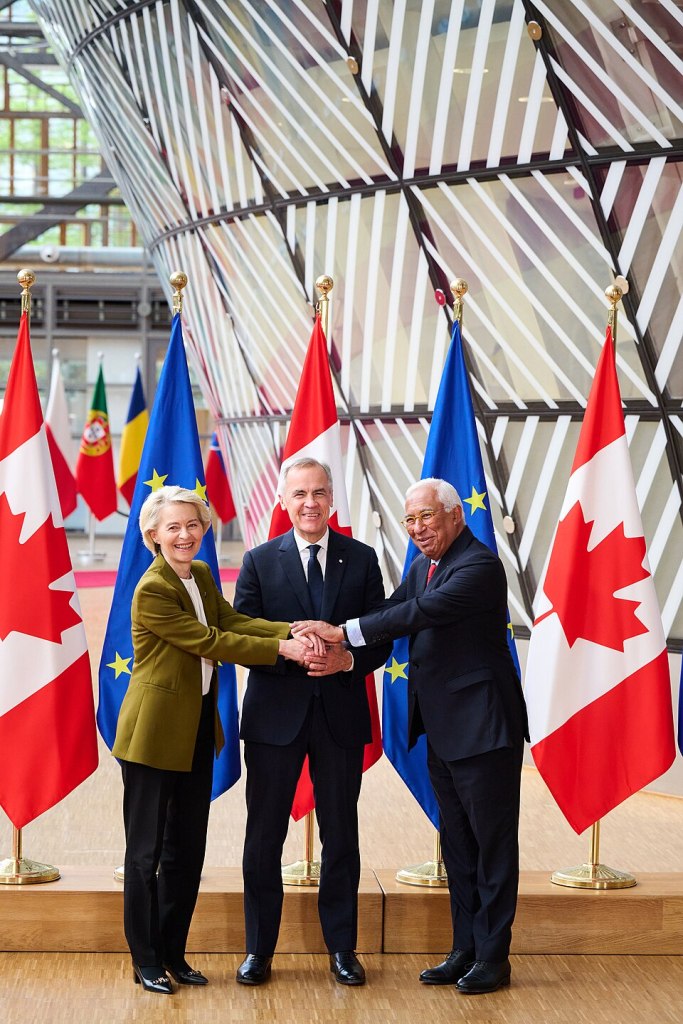
© European Union, 2026, CC BY 4.0 https://creativecommons.org/licenses/by/4.0, via Wikimedia Commons

By MJ Weaver
Two weeks ago, the European Union (EU) invited Canda to become its first “associate member.” This proposal by the European Commission President, Ursula von der Leyen, left many questioning what this new membership would entail and how it would be achieved within the current EU membership framework. Associate membership does not formally exist within the EU and would require further approval from all 27 EU member states. Although not mentioned as a reason, the proposal comes at a time of sweeping U.S. sanctions against Canada amid a new trade war, and as efforts to reduce U.S. defense support for NATO and Ukraine increase. The redefined EU-Canada relationship could signal a shift away from a challenging relationship with the United States and the current Trump administration.
Canadian Prime Minister Mark Carney has expressed interest in furthering Canada’s alliance with the EU and exploring the possibility of becoming an “associate member.” Associate membership would strengthen an already thriving relationship between the EU and Canada, which currently have a free-trade agreement and long-standing alliance. The agreement could focus on promoting cooperation in technology, defense, energy, manufacturing, economic security, critical minerals, and the free movement of people. Carney stated that Canada could help support European energy security by supplying liquefied natural gas and hydrogen, while seeking Europe’s expertise in clean energy technology. He also suggested Canada join the EU’s Erasmus program, promoting educational, technological, and cultural ties.
A mixed-model membership would need to clearly define Canada’s role within the EU: Would Canada join the single market? Would it have a vote within the European parliament? Would other non-regional alliances be invited to apply for associate membership? Associate membership would make it easier for Canada to align with the EU without the difficulties of becoming an official member state. There are currently nine candidate countries seeking membership, a process that is often prolonged, and preferential treatment for Canada could undermine those efforts and frustrate candidate countries.
The EU and Canada have stated that their values align and will continue to strengthen their relationship regardless of the proposed associate membership. If the two parties are successful in joint defense efforts, their combined resources could strengthen the Western security bloc while relieving the United States of some of its the fiscal and operational burden within NATO and Ukraine. The new role could also entice the United Kingdom to rebuild their relationship with the EU amid its current economic struggles. These details and concerns are expected to be discussed at the upcoming October 2026 EU-Canada summit.


Leave a comment