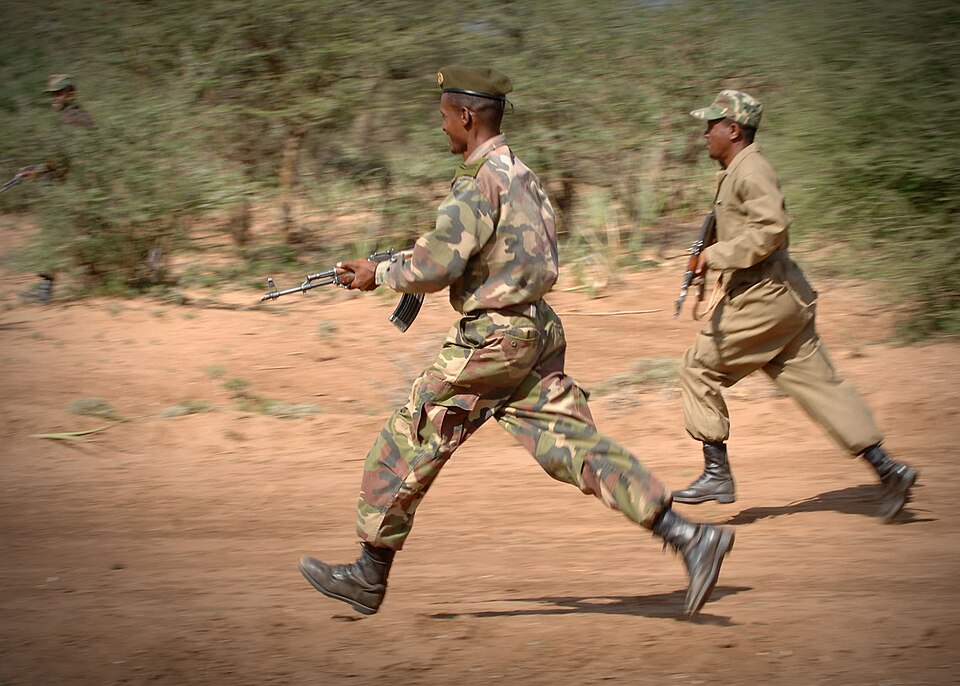
DoD photo by: MCC(AW/SW ERIC A. CLEMENT, Public domain, via Wikimedia Commons

By Brooke Bihl
Renewed fighting throughout northern Ethiopia breaks out after a peace deal that ended the civil war between the Tigrayan rebels and the Ethiopian federal government nearly four years ago breaks apart. Authorities in the Tigray region released on Wednesday that they had begun mobilizing their forces against the federal government after claiming the government launched a “full-scale offensive” involving infantry, artillery, and drones. In addition, Tigrayan forces recently took control of three airports located in the city of Mekelle, as well as other northern cities, prompting Ethiopian airlines to suspend flights to the affected airports. These recent hostilities have shattered a 2022 peace agreement that ended one of the deadliest conflicts in contemporary history, which killed around 600,000 people. While major actors remain the Tigray People’s Liberation Front (TPLF) fighting against the federal Ethiopian government, forces that were once enemies are now fighting side-by-side.
The outbreak of new fighting follows months of animosity that has grown since the TPLF formed an alliance between six other armed groups, all aiming to overthrow the Ethiopian Prime Minister Abiy Ahmed’s government. Named the “Alliance for Survival”, the new coalition is made up of rebel groups located in the Amhara, Ogaden and Afar regions of the country, which are strategically located in an area around the Ethiopian capital, Addis Ababa. In a joint statement, the rebel groups associated with the TPLF accused Prime Minister Abiy of pursuing dictatorial policies and vowed to form an inclusive, democratic government once in power. “We, the people’s forces concerned with the survival of Ethiopia’s peoples, bear the historic responsibility of overthrowing this regime,” they said in the statement.
The region of Tigray, which borders Eritrea, is inhabited mainly by the Tigrayan ethnic group and has played a crucial role in Ethiopian politics since its forces led a coalition that overthrew a military regime in 1991. Trigrayan soldier/politician, Meles Zenwai governed Ethiopia as an autocracy from 1991 until his death in 2012 with backing from a TPLF dominated coalition. During his regime, the country undertook significant reforms which propelled it into a prominent international actor and sustained rapid economic development, though his government also widely marginalized ethnic groups in order to retain power. The TPLF continued governing Ethiopia until 2018, when Abiy Ahmed Ali was appointed the next prime minister. Abiy brought new hopes for renewed peace and ethnic harmony while in 2019, he received a Nobel Peace Prize for negotiating an end to a two-decade conflict with Eritrea.
However, by 2020, ethnic tensions within Ethiopia began to escalate amid repeated delays of promised national elections along with an extension of Abiy’s first term, which brought indignation from the TPLF. After the Tigray’s State Council’s decision to hold local elections ultimately solidified TPLF control back over the region, Abiy accused Tigrayan troops of attacking a federal military camp, prompting the advancement of Ethiopian National Defense Force (ENDF) troops, marking the outbreak of the brutal two year war that displaced millions and brought accusations of ethnic cleansing. After a series of negotiations to end the war, the TPLF and Ethiopian government agreed to sign the Pretoria Agreement in 2022, which disarmed Tigrayan troops, gave the Ethiopian government control over the Tigray region, permitted humanitarian access to the region, and immediately halted all fighting.
Since then, tensions and ongoing flare-ups have continued to threaten the peace agreement and broader stabilization within the Horn of Africa. Particularly between Ethiopia and Eritrea, which hold decades of intertwined conflict, hostilities from Eritrean forces have grown over Ethiopia’s push for access to the Red Sea through Eritrean port of Assad. In addition, wider rivalries include Sudan’s ongoing civil war, which has reignited tensions with Ethiopia over the fertile region of Al Fashaga, where government tensions have existed since the early 1900s. Recent reports state that the Sudanese army has hosted thousands of Tigrayan fighters in territory under its control while Ethiopia has provided backing to the Rapid Support Forces (RSF), who are in direct conflict with the Sudanese army. Although Ethiopia has rejected these claims, the country remains a close ally of the United Arab Emirates (UAE), which is widely seen as the RSF’s main backer. These conflicting interests, as well as Ethiopia’s ongoing construction of the Grand Ethiopian Renaissance Dam, threaten to spark a regional war that causes severe humanitarian consequences far beyond Ethiopia’s civil war in 2020. Therefore, a window for averting these outcomes is slowly closing, prompting immediate action for international and regional diplomatic solutions.


Leave a comment