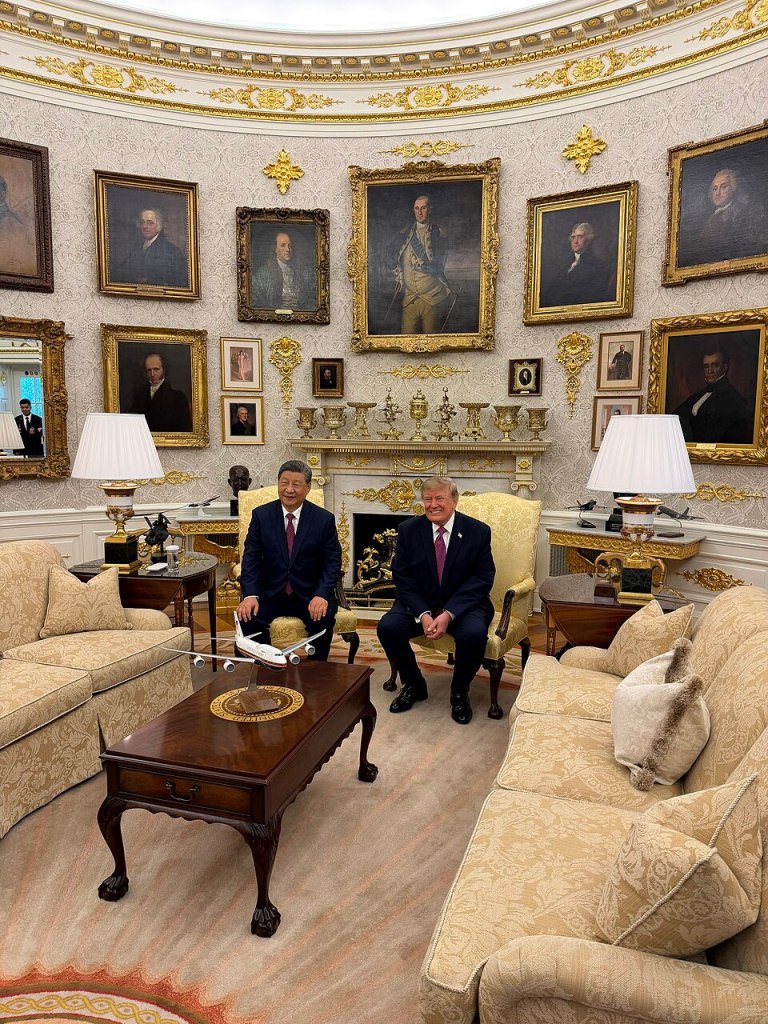
Margo Martin, Public domain, via Wikimedia Commons

By Taylor Bishop
On September 24, 2026, President Donald Trump and Chinese leader Xi Jinping met for the next round of high-level talks amid rising tensions between the two powers, this time in Washington, D.C. In the months and weeks leading up to the event, scholars and policy analysts discussed potential topics and issues the two leaders might address. Chief among them were renewing the temporary truce in the ongoing trade war, the AI race, and avoiding escalation over regional and global issues such as Taiwan and Iran.
While the diplomatic jargon and strategic wordplay are hard to parse, a few things about the event’s results are clear. First, a renewed truce in the trade war appears to be in effect until January 2027. Treasury Secretary Scott Bessent confirmed this ahead of the meeting between the two heads of state. As announced, China appears committed to importing roughly 10 million metric tons of U.S. coal annually in 2027 and 2028. The U.S.-China Board of Trade and Board of Investment has been launched, with an additional recommendation from the former to reduce reciprocal tariffs on 30 billion in non-sensitive goods. The system, per the White House, would follow a 30-for-30 framework, under which each country can import 30 billion in non-sensitive goods in each direction. These goods, exported from the U.S., included roughly 1,619 items, including agricultural commodities like corn, wheat, and dairy, personal care products, timber, and even medical equipment. The list did not include soybeans. The industry in the United States has faced a serious hit since China placed a 10% reciprocal tariff on the product. Why? Some believe China is using the industry as leverage in future discussions, but it remains to be seen whether both sides will seriously commit to another bilateral discussion.
What about AI? While both countries seem locked in an AI race, the conversation at the meeting lacked any serious material toward a resolution. For both sides, the issue matters: in the United States, fears persist that China’s distilling AI models, and in China, there is a push to secure easements in export controls on sophisticated semiconductors to help advance its own models.
Was Taiwan mentioned? The dialogue and post-meeting language on the issue seem to have produced an unclear message. What is clear is that Xi urged President Trump to oppose Taiwan’s independence. What about the hotly debated 14 billion arms sale to Taiwan? On Sunday, September 27, U.S. Ambassador to China David Perdue told Fox News that Trump offered Xi the chance to buy the arms from the United States, a move that upset many who feared that such a sale would reverse many of the policies the U.S. has pursued with the island. That said, the State Department also reiterated that U.S. law prohibits arms sales to China.
Outside of the trade sphere, President Xi announced that China would send two pandas: a male named Ping Ping and a female named Fu Shuang. These “envoys of friendship” will travel to the Atlanta Zoo. Interestingly, Panda diplomacy has been a soft-power tool in contemporary times since Mao Zedong rose to power. Whether intended or not, Ping Ping shares a name with another panda that China loaned to the Soviet Union in the early Cold War years.
Beyond the pleasantries in the diplomatic dialogue between the two entities, many experts and policy analysts who watched the meeting seem to indicate that, beyond a select few items that still remain to be seen in full, most of what occurred at the summit lacked substance in de-escalation or resolution on major issues such as AI, Taiwan, or reducing Chinese support for Iran and Russia. That said, a consistent message across the board was to continue dialogue and pursue a peaceful resolution to ongoing concerns between the two countries. To support this continued pursuit of communication, one step was establishing a bilateral communication channel for Super Intelligence (SI) or Artificial Intelligence (AI) incidents; another was both sides recalling their commitments and alliances during World War Two.
As we enter the midterm elections and future summits, the question remains whether the two leaders will meet bilaterally again. They could potentially meet twice more this year. The first is in November, when President Xi hosts the Asia-Pacific Economic Cooperation Summit in China, and potentially again in December during the Group of 20 (G20) summit in Miami. What does this indicate in the grand scheme of things about U.S.-China relations? Some scholars believe continued dialogue and commitment to meeting ensures some form of management between the two sides, despite continued concerns over trade, Taiwan, AI, and other broader issues. Essentially, each side is held to an obligation of accountability and a policy of not further escalating the situation.


Leave a comment