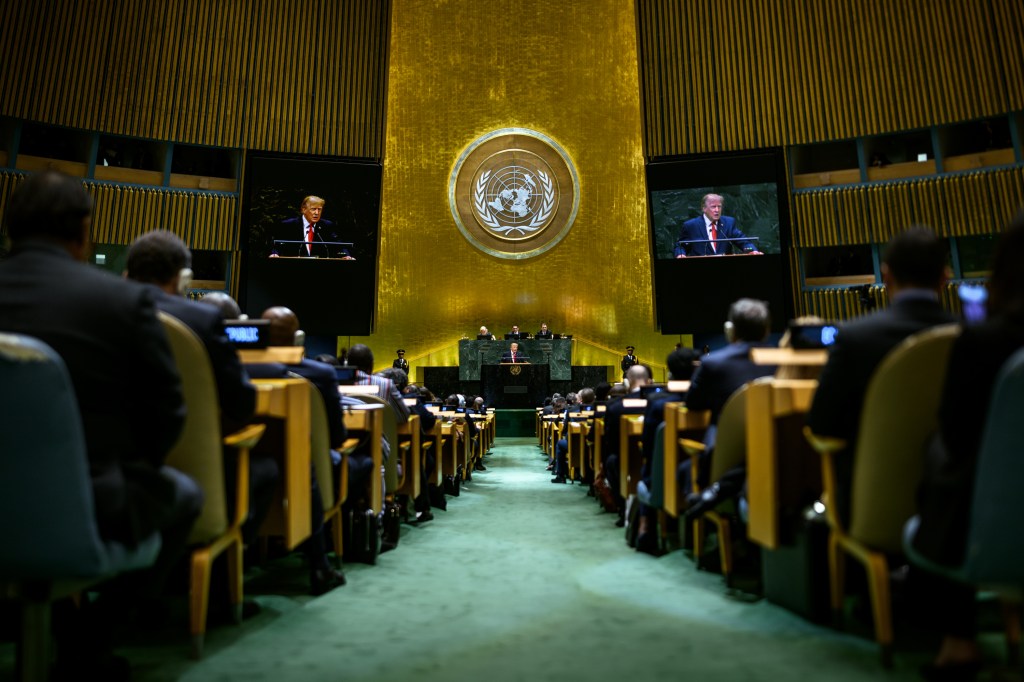
The White House, Public domain, via Wikimedia Commons

By Katie Braman
On September 8, 2026, the United Nations General Assembly (UNGA) kicked off its 81st session with the first plenary meeting at its headquarters in New York City. The UNGA is the main policy-making body of the United Nations, and contrary to the Security Council, each member has an equal vote. Some of the most important policy decisions they make are appointing the UN Secretary-General, electing the Security Council’s rotating members, and approving the UN budget. Regular session meetings occur September through December, though the session itself lasts until the following September. The current President of the General Assembly is Khalilur Rahman of Bangladesh. President Rahman chose the theme of this session as “Restoring Trust, Managing Transformation: A United Nations That Delivers for All”.
The session opened with three days of addresses by the Heads of State. Some of the most memorable and highly anticipated speeches came from President Donald Trump of the United States, Prime Minister Benjamin Netanyahu of Israel and President Masoud Pezeshkian of Iran. President Trump criticized Iran and defended the US war with the Islamic Republic by citing a refusal to allow the country to have nuclear capabilities, claiming to face a decision whether to pursue peace or “annihilate” the country. He also criticized UNESCO, the United Nations’ economic, social, and educational cooperation arm, for promoting immigration that contradicts the Trump administration’s policies. President Trump defended many of his domestic political decisions to the UN, but many of those remarks fell short on international ears.
In one of the most dramatic displays at this year’s session, many delegations left the UNGA floor upon the introduction of Israeli Prime Minister Benjamin Netanyahu. The UN Human Rights Council has continuously criticized Israel for the war in Gaza, publishing a report in September 2025 claiming the state had committed genocide against Palestinians in Gaza. Prime Minister Netanyahu criticized the UN for characterizing his regime as genocidal and defended his war against Iran and Hamas.
Iranian President Masoud Pezeshkian criticized the US and Israel for the war and highlighted the impacts on Iranian citizens. He stood firmly against the US and Israel and claimed that Iran will not give up their pursuit of nuclear energy, citing it as critical to the country’s advancement. He criticized Israel heavily for its actions against Gaza and claimed their nuclear capabilities were the root of destabilization in the region, not Iran’s actions.
The final High-level meeting of the 81st session concluded on September 29 with the meeting to commemorate and promote the International Day for the Total Elimination of Nuclear Weapons. This 81st session will continue meeting through the end of the year and into next year in lower lever meetings and debates as they decide on the adoption of new resolutions and move to elect the new UN Secretary-General.


Leave a Reply