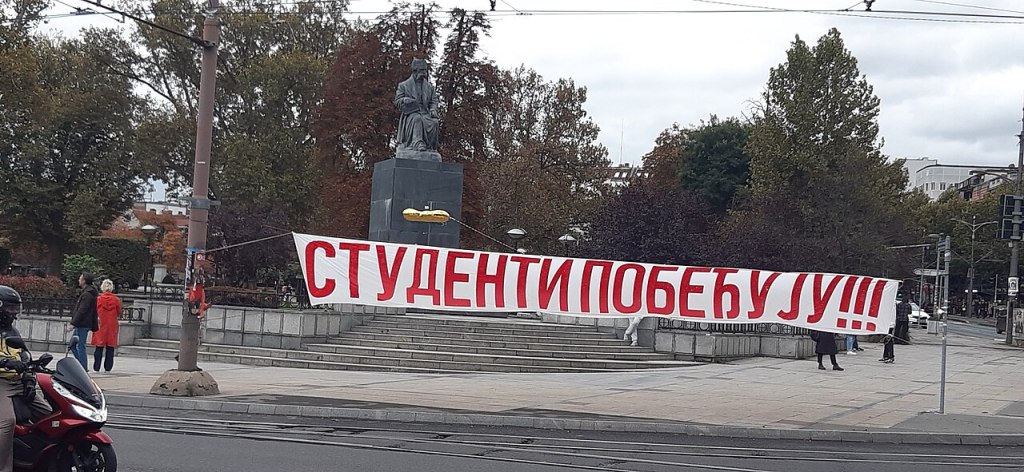
Emilija Knezevic, CC BY 4.0, via Wikimedia Commons

By Ionut Moga
On Sunday, October 25th, Serbia held Parliamentary elections, and a new party, the Student List, won the elections by defeating the Serbian Progressive Party (SNS), whose leader is Aleksandar Vučić. The Student List won the Election, with them receiving about 53% of the vote, while the SNS party only received about 40% of the vote, with the rest of the votes going to smaller parties. This election victory came off of student protests that began about two years ago when sixteen people died at the train station in Novi Sad when a renovated canopy collapsed on the train station as a result of corruption that involved building the canopy itself.
One of the most telling statistics in this election was the high rate of participation in the election with the fact that the percentage of eligible voters who participated was about 70%, which was the highest since the breakup of Yugoslavia which took place in 1992. Another thing that is interesting about this election, going beyond the voter turnout is that most of the people in the Student List are not career politicians. They have a variety of backgrounds such as doctors, farmers, professors, and activists. All of them came together for a common cause, thus being key critics of the Vučić administration.
A majority of the Vučić critics believe that he was an authoritarian leader who denied Serbians freedom. One of the most significant predictions that can be made given the result of this election is the likely increase in the freedom of the press in Serbia. The leader of Serbia’s state broadcaster, the RTS Channel, has stepped down after Vučić’s loss. In addition, one of the members of the Student List mentioned how Serbian citizens were entitled to a press that was honest and fair to all members of society and not just to serve the interests of certain political parties or individuals. This wave of democracy in Serbia was so strong that despite Vučić’s fury with the election result, he accepted the result and said that he would try to come back to power through the likely democratic process that will be in place in future elections for the country.
Domestic policy in Serbia could consist of a variety of policies. One idea that could arise as a result of this election is a lustration law, which would bar all people who are related to the previous government from running for office for a certain period of time. This is similar to an idea that some people had when Communism fell in Romania that was expressed through the Timişoara Proclamation, which had an article that key members of the Romanian Communist Party do not run for three consecutive election cycles. Even though it was never approved in Romania, that could be a possible framework that the new Serbian government might choose as a path forward to ensure that tyranny does not come to Serbia again. Another idea that the Serbian Government might instill is to create laws that fight corruption in the country. That is significant so that corruption cases like the one in Novi Sad do not happen ever again in the country. On a related note, a promise was made that with the money that the Serbian government would confiscate money that came from these corrupt deals, like the Novi Sad case, and return that money to the state budget so that investments in capital can be made, such as education. That is important for Serbia because reducing corruption and investing in human capital ultimately improves the lives of people, as indicated through key economic development theories.
Beyond the territory of Serbia, this election has some significant ramifications for Serbia’s Foreign Policy. One of the likely outcomes is that relationships with the European Union are likely to improve given the fact that the Student List is likely to uphold the rules of democracy in the future. As a result of this, Serbia’s relationship with one of its allies, Russia, may deteriorate. However, the relationship with Russia may not deteriorate in the short term given that the Student List is likely to continue the policy of the previous administration of not sanctioning the Russian Federation. Another foreign policy idea to consider is the historical rivalry that Serbia and Kosovo have. With this new government, there may be steps to start dialogue with the government of Kosovo after years in which neither government has had dialogue with one another.
In conclusion, Serbia’s future after the past elections is likely to be a democratic one because of all of the reforms that the Student List wants to achieve. With foreign policy considerations, Serbia may have friendlier relations with the traditional democracies of the world, but many foreign policy initiatives in the past are likely to stay the same.


Leave a Reply